
Legacy Fieldbus, BMS & PLC Protocols Integration Guide
Connecting Legacy BACnet/IP & MS/TP, Windows COM/DCOM OPC DA 2.05a, Modbus RTU/TCP, Siemens S7comm (S7-300/400), Allen-Bradley DF1/PCCC, and 4–20 mA HART Instruments to GxPHistorian GxP Industrial Historian
1. Overview: Replacing Legacy OSIsoft PI Interfaces in Brownfield Biopharma Plants
In established cGMP biopharmaceutical facilities, critical equipment—steam sterilizers (autoclaves), Clean-in-Place (CIP) skids, chromatography workstations, cleanroom HVAC/EMS controllers, WFI loops, and stability chambers—often predates OPC UA by 10 to 25 years. Historically, connecting these systems required purchasing and maintaining separate proprietary OSIsoft / AVEVA PI Interfaces:
| Legacy Protocol / Physical Layer | Traditional OSIsoft / AVEVA PI Interface | GxPHistorian GxP Historian Equivalent (edge-collector) | Typical Biopharma Equipment |
|---|---|---|---|
BACnet/IP & BACnet MS/TP (UDP :47808 / RS-485) | PI Interface for BACnet | edge-collector/scripts/bacnet_cov_worker.py (bacpypes3) | Cleanroom EMS differential pressure cascades, HVAC AHUs, walk-in stability & cold rooms (, ) |
| Classic OPC DA 2.05a / 3.0 (Windows COM/DCOM) | PI Interface for OPC DA + PI Buffer Subsystem | edge-collector/scripts/opcda_windows_forwarder.py (OpenOPC + LocalSpoolBuffer) | Cytiva UNICORN™ 5/6/7, Emerson DeltaV™ OPC Mirror, Rockwell RSLinx Classic, Sartorius MFCS/win 3 |
Modbus RTU (RS-485/RS-232) & Modbus TCP (:502) | PI Interface for Modbus Ethernet / Serial | Telegraf [[inputs.modbus]] (TCP & rtuovertcp via Moxa NPort) | Veolia Sievers® 900/M9 TOC, PMS LasAir® II/III particle counters, Hamilton Arc® RS-485 probes, Brooks MFCs, Binder stability chambers |
Siemens S7comm (RFC 1006 ISO-on-TCP :102) | PI Interface for Siemens S7 | Python snap7 / [[inputs.s7comm]] worker :8080/ingest | Fedegari / Getinge autoclaves, legacy Sartorius Biostat® D-DCU, Syntegon/Bosch vial washers & depyrogenation tunnels, CIP skids |
| Allen-Bradley DF1 / PCCC / EtherNet/IP (PLC-5 / SLC 500) | PI Interface for Allen-Bradley DF1 / CIP | Python pycomm3 (SLCDriver / LogixDriver) worker :8080/ingest | Legacy Millipore TFF skids, Paul Mueller WFI storage & distribution skids, lyophilizer refrigeration skids |
| 4–20 mA Analog + HART (Bell 202 FSK) | PI Interface for HART / Cornerstone | HART-to-Modbus TCP Multiplexer [[inputs.modbus]] | Legacy Rosemount / Endress+Hauser sanitary pressure, level, PT100 RTD, and Micro Motion Coriolis flow transmitters |
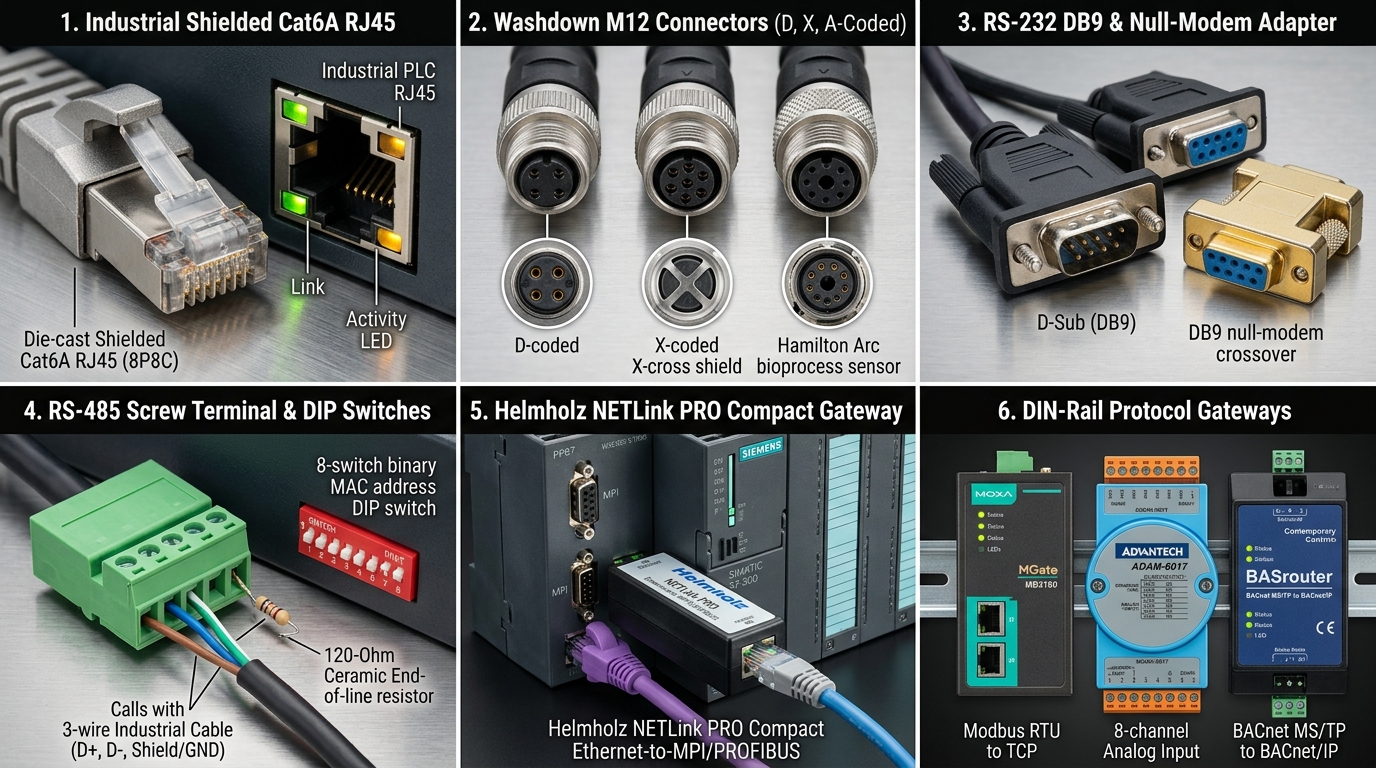
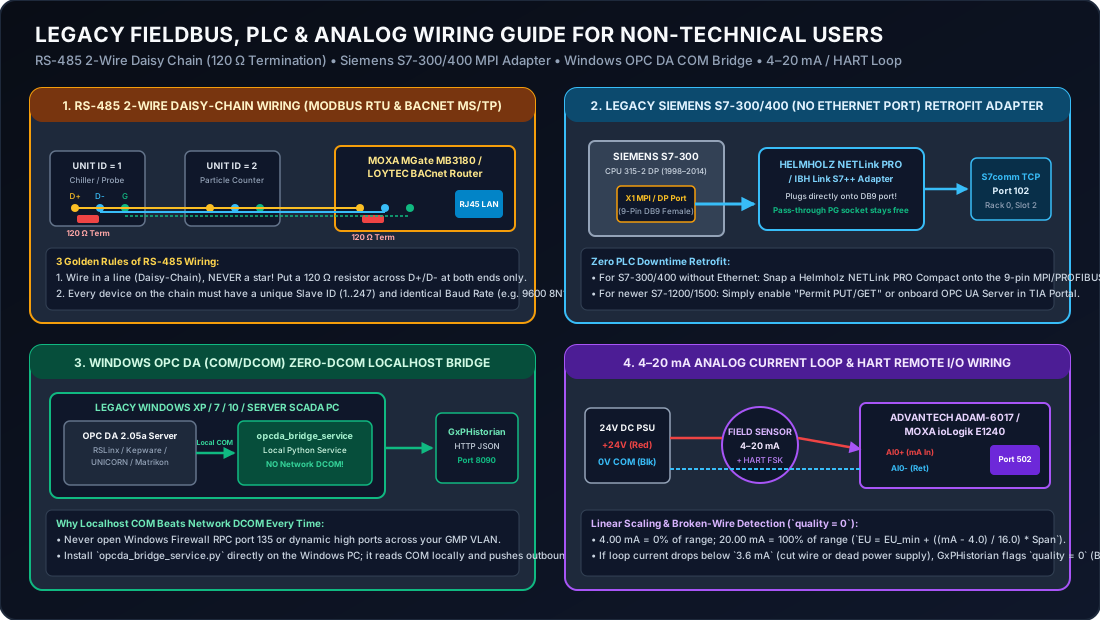
1.5 Non-Technical Step-by-Step Physical Wiring & Adapter Guide
If your facility has older equipment from the 1995–2015 era that lacks an OPC UA server or even lacks an Ethernet port, you do not need to replace the equipment or upgrade its validated PLC code. Here is the exact hardware adapter to buy and how to wire it in under 15 minutes:
| Legacy Situation | What Hardware Adapter to Buy | How to Physically Wire It | How GxPHistorian Reads It |
|---|---|---|---|
1. Equipment has a 2-Wire or 3-Wire RS-485 Screw Terminal (D+, D-, GND) | Moxa MGate MB3180 (for Modbus RTU, $160) or Contemporary Controls BASrouter (for BACnet MS/TP, $390) | Wire D+ to D+, D- to D-, and GND to GND in a single Daisy-Chain line (never wire RS-485 in a star!). Place a termination resistor across D+ and D- at the first device and at the gateway terminal block. | Gateway converts serial frames into Modbus TCP (Port 502) or BACnet/IP (UDP 47808) on your Ethernet LAN. |
2. Legacy Siemens S7-300 / S7-400 Autoclave or CIP Skid has NO Ethernet Port (only a 9-Pin MPI / PROFIBUS DB9 socket) | Helmholz NETLink® PRO Compact or IBH Link S7++ RJ45-to-MPI/PROFIBUS Plug Adapter (~$450) | Snap the adapter directly onto the 9-pin female MPI / DP port (X1) on the front of the S7-300/400 CPU. It draws power directly from the PLC port and provides a pass-through socket so your local HMI stays connected! Plug a Cat6 cable into the adapter’s top RJ45 port. | edge-collector polls the S7-300/400 Data Blocks (DB) over RFC 1006 ISO-on-TCP (Port 102, Rack 0, Slot 2) with zero PLC program changes. |
3. Legacy Windows XP / 7 / 10 PC runs an OPC DA 2.05a Server (UNICORN, RSLinx, Kepware) | Zero hardware required (or a $20 USB-to-Ethernet adapter if the PC only has 1 NIC) | Never open Windows DCOM port 135 across the network! Copy edge-collector/scripts/opcda_windows_forwarder.py onto the Windows PC. | Reads COM OPC DA locally on localhost (127.0.0.1), buffers on disk (opcda_spool.jsonl), and pushes outbound HTTP JSON batches to edge-collector:8080/ingest. |
4. Standalone 4–20 mA Analog Transmitter or PT100 RTD Temperature Probe | Advantech ADAM-6017 (8-Ch 4–20 mA to Modbus TCP, $240) or Advantech ADAM-6015 (7-Ch PT100 RTD, $240) | Wire your power supply +24V to the sensor +, sensor - to AI0+ on the ADAM module, and AI0- back to 0V COM. Plug a Cat6 cable into the ADAM module’s RJ45 port. | Polls milliamps over Modbus TCP (Port 502), scales linearly to engineering units, and flags quality = 0 (Bad) if loop current drops below (cut wire). |
2. End-to-End Legacy Protocol Architecture
flowchart LR
  subgraph Legacy["Legacy Cleanroom, Utility & Skid Equipment (Purdue Level 1/2)"]
    MSTP["BACnet MS/TP RS-485 Bus\n(Room DP, VAVs, Stability Chambers)"]
    ROUTER["BACnet/IP Router & BBMD\n(UDP :47808)"]
    OPCDA_PC["Windows Skid Workstation\n(UNICORN / RSLinx / DeltaV COM OPC DA)"]
    RTU["Modbus RTU RS-485 Multi-Drop\n(Hamilton Arc, MFCs, LasAir, Sievers TOC)"]
    MOXA["Moxa NPort / Modbus Gateway\n(TCP :502)"]
    S7PLC["Siemens S7-300 / S7-400 PLC\n(Autoclave / CIP Skid ISO-on-TCP :102)"]
    MSTP -->|"EIA-485 (9600–76800 bd)"| ROUTER
    RTU -->|"EIA-485 2-Wire"| MOXA
  end

  subgraph Edge["Pillar 1: Edge Collector (edge-collector)"]
    BAC_W["bacnet_cov_worker.py\n(Status_Flags -> OPC Quality)"]
    DA_W["opcda_windows_forwarder.py\n(Localhost COM + Disk Spool)"]
    MOD_IN["Telegraf [[inputs.modbus]]\n(Byte/Word Swap Normalization)"]
    S7_W["S7comm / PLC Worker\n(DB Offset Reader + ExcDev)"]
    ING["HTTP Ingest (:8080/ingest)"]
    WAL["Telegraf Disk WAL\n(/var/lib/telegraf/buffer)"]

    BAC_W --> ING
    DA_W -->|"Outbound HTTP JSON"| ING
    S7_W --> ING
    ING --> WAL
    MOD_IN --> WAL
  end

  subgraph Core["GxPHistorian GxP Historian (Purdue Level 3)"]
    CH["ClickHouse 24.8 Archive\n(pi_historian.sensor_data)"]
    PG["PostgreSQL 16 Control Plane\n(Part 11 Audit + Event Frames)"]
  end

  ROUTER -->|"UDP :47808"| BAC_W
  OPCDA_PC -->|"Localhost COM"| DA_W
  MOXA -->|"TCP :502"| MOD_IN
  S7PLC -->|"RFC 1006 (:102)"| S7_W
  WAL -->|"JSONEachRow"| CH
  PG <--> CH
3. Deep Dive & Examples by Legacy Protocol
3.1 BACnet/IP & Legacy BACnet MS/TP (Cleanroom EMS & Stability Chambers)
Understanding Legacy BACnet Topologies in Biopharma
- BACnet MS/TP (Master-Slave/Token-Passing over EIA-485):
- Localized cleanroom pressure controllers (e.g., Setra, Phoenix Controls, Siemens DXR, Johnson Controls FEC) often sit on a 2-wire RS-485 daisy chain running at
38400or76800baud. - An MS/TP-to-BACnet/IP Router (e.g., Contemporary Controls BASrouter or Loytec LVIS) bridges the RS-485 trunk onto the Ethernet network (
UDP 47808). - In
bacpypes3(edge-collector/scripts/bacnet_cov_worker.py), devices behind a BACnet router are addressed usingDNET:DADRrouting notation (e.g.,"2001:14", where2001is the MS/TP network number and14is the 8-bit MAC address on the RS-485 trunk) or via the router’s IP.
- Localized cleanroom pressure controllers (e.g., Setra, Phoenix Controls, Siemens DXR, Johnson Controls FEC) often sit on a 2-wire RS-485 daisy chain running at
- Traversing Subnets/VLANs with BBMD & Foreign Device Registration (FDR):
- Standard BACnet discovery (
Who-Is/I-Am) uses local UDP broadcasts that are blocked by Layer 3 cleanroom VLAN routers. - Because
AsyncBacnetTelemetryWorkerinedge-collector/scripts/bacnet_cov_worker.pyuses directed unicastReadProperty(Address("192.168.10.30:47808")) rather than relying on broadcast discovery, it traverses Layer 3 firewalls cleanly with onlyUDP 47808permitted—even if no BBMD is deployed on the Historian VLAN.
- Standard BACnet discovery (
- Why
ReadPropertyPolling with Edge Deadband Outperforms LegacySubscribeCOV:- Older field controllers have tiny RAM tables (often supporting only 5–16 active
SubscribeCOVsubscriptions before returningError: resources / no-space-for-object). - Polling
presentValueandstatusFlagsevery 1–5 seconds inbacnet_cov_worker.pyand applying Stage 1exc_dev/exc_maxfiltering in the Edge Collector completely avoids controller COV table exhaustion while achieving identical compression in ClickHouse.
- Older field controllers have tiny RAM tables (often supporting only 5–16 active
Example: Polling Direct BACnet/IP & Routed BACnet MS/TP Controllers (bacnet_cov_worker.py)
from bacnet_cov_worker import AsyncBacnetTelemetryWorker, BacnetPointSpecimport asyncio
worker = AsyncBacnetTelemetryWorker(    ingest_url="http://localhost:8080/ingest",    points=[        # 1. Direct BACnet/IP Cleanroom ISO-7 Differential Pressure Transmitter        BacnetPointSpec(            tag_id=301,            device_address="192.168.10.30:47808",            object_identifier="analog-input,1",            exc_dev=0.10,   # Emit on >= 0.10 Pa change            exc_max=10.0,   # Or every 10s heartbeat        ),        # 2. Legacy BACnet MS/TP Stability Chamber (2-8 degC) on MS/TP Network 2001, MAC Address 14        #    Routed via BACnet/IP Router at 192.168.10.1        BacnetPointSpec(            tag_id=305,            device_address="2001:14@192.168.10.1:47808",            object_identifier="analog-input,0",            exc_dev=0.05,   # Emit on >= 0.05 degC change            exc_max=30.0,        ),    ],)asyncio.run(worker.poll_cycle())
3.2 Classic Windows COM/DCOM OPC DA 2.05a (opcda_windows_forwarder.py)
Why Traditional Remote OPC DA Fails in Modern GMP Plants
Legacy OPC DA 2.05a relies on Microsoft DCOM (Distributed Component Object Model):
- Initial handshake occurs on
TCP 135(RPC Endpoint Mapper), which then dynamically assigns an arbitrary high port (49152–65535). - Requires matching Windows NTLM workgroup credentials or bidirectional Active Directory trust between the Level 2 skid PC and the Level 3 historian node.
- Microsoft hardened DCOM authentication (
KB5004442packet integrity enforcement), breaking legacy anonymous/unencrypted DCOM connections to older Windows 7 / Windows 10 LTSC skid workstations.
The GxPHistorian Zero-DCOM Solution
Run edge-collector/scripts/opcda_windows_forwarder.py directly on the Windows OPC DA workstation as a local Windows service (using a 32-bit Python environment if the vendor OPC server is a 32-bit COM DLL/EXE registered under HKLM\SOFTWARE\WOW6432Node\Classes):
- Localhost COM Only:
self._opc_client.connect(self.prog_id, "localhost")communicates strictly within the local Windows kernel via LRPC (Local RPC)—zero inbound firewall ports are opened on the skid PC. - Quality Normalization:
map_opcda_quality()converts COM quality strings ("Good","Good: Local Override","Uncertain","Bad: Sensor Failure") to standard integer OPC quality codes (192,64,0). - Store-and-Forward Spool (
LocalSpoolBuffer): If the plant network drops, telemetry is appended to./opcda_spool.jsonlon the Windows PC and automatically drained in FIFO batches (drain_batches(max_items=500)) as soon ashttp://<edge-collector>:8080/ingestis reachable again.
Common Biopharma OPC DA ProgID Reference
| Vendor Software Platform | Standard Windows COM ProgID |
|---|---|
| Cytiva UNICORN™ 5 / 6 / 7 (ÄKTA™) | UNICORN.OPCServer.1 |
| Emerson DeltaV™ OPC Mirror | OPC.DeltaV.1 |
| Rockwell Automation RSLinx Classic | RSLinx OPC Server or RSLinx Remote OPC Server |
| Sartorius BioPAT® MFCS/win 3 | Sartorius.MFCS.OPCServer |
| Siemens SIMATIC NET / WinCC | OPC.SimaticNET or OPCServer.WinCC |
| Matrikon OPC Simulation / Tunneller | Matrikon.OPC.Simulation.1 |
3.3 Legacy Modbus RTU (RS-485 / RS-232) & Modbus TCP (:502)
Solving the Three Classic Modbus Integration Traps
When connecting legacy Modbus RTU (2-wire RS-485 via a Moxa NPort serial device server) or Modbus TCP analyzers (Sievers TOC, PMS LasAir particle counters, Hamilton Arc sensors, Brooks MFCs, Binder stability chambers), three protocol pitfalls frequently corrupt readings if not configured properly:
- Trap 1 — Word & Byte Endianness (
ABCD,CDAB,BADC,DCBA):- The Modbus specification only defines 16-bit registers (
uint16); it never standardized how a 32-bit IEEE-754 floating-point number (FLOAT32-IEEE) is split across two consecutive 16-bit registers (Reg NandReg N+1). - Big-Endian (
ABCD): High word first, high byte first (used by PMS LasAir® and many modern transmitters). - Word-Swapped (
CDAB): Low 16-bit word inReg N, high 16-bit word inReg N+1(used by Schneider/Modicon PLCs, older Sievers® 900/M9 firmware modes, and Hamilton Arc® Modbus RTU registers). - Fix: Set
byte_order = "CDAB"or"ABCD"per register block in Telegraf[[inputs.modbus]].
- The Modbus specification only defines 16-bit registers (
- Trap 2 — 1-Based Modicon Documentation vs. 0-Based Wire Addressing:
- Vendor manuals often list Holding Registers as
40301(Modicon 5-digit) or400301(Modicon 6-digit). - On the wire, Function Code
03(holding_registers) uses 0-based indexing:40301= Function Code03, address300(301 - 1).
- Vendor manuals often list Holding Registers as
- Trap 3 — Fixed-Point Integer Scaling (
INT16/UINT16with Implied Decimals):- Legacy controllers (such as Binder stability chambers or Eurotherm 2404/3504 temperature controllers) store
37.05 °Cas signed 16-bit integer3705(scale = 0.01) or37.1 °Cas371(scale = 0.1). - Fix: Set
data_type = "INT16"andscale = 0.01in[[inputs.modbus]]so ClickHouse receives the true floating-point engineering value (37.05).
- Legacy controllers (such as Binder stability chambers or Eurotherm 2404/3504 temperature controllers) store
Example: Complete Multi-Device Legacy Modbus Configuration (telegraf-clickhouse.conf)
# 1. Legacy RS-485 Modbus RTU Hamilton Arc Incyte/VisiFerm Probes behind a Moxa NPort Gateway[[inputs.modbus]]  name_override = "sensor_data"  controller = "tcp://10.20.60.50:4001"  transmission_mode = "RTUoverTCP"  slave_id = 2  timeout = "2s"  configuration_type = "register"
  holding_registers = [    # Hamilton VisiFerm Optical DO (%Sat) at 0-based register 2088, word-swapped CDAB Float32    { name = "val", byte_order = "CDAB", data_type = "FLOAT32-IEEE", scale = 1.0, address = [2088, 2089] }  ]  [inputs.modbus.tags]    tag_id = "104"
# 2. Legacy Eurotherm / Binder GMP Stability Chamber Controller (Fixed-Point INT16 with 0.01 scale)[[inputs.modbus]]  name_override = "sensor_data"  controller = "tcp://10.20.60.55:502"  transmission_mode = "TCP"  slave_id = 1  timeout = "2s"  configuration_type = "register"
  input_registers = [    # Chamber Temperature PV (raw 2504 -> 25.04 degC)    { name = "val", byte_order = "AB", data_type = "INT16", scale = 0.01, address = [1] }  ]  [inputs.modbus.tags]    tag_id = "801"
3.4 Legacy Siemens S7-300 / S7-400 (S7comm Port 102) for Autoclaves & CIP Skids
Many validated Fedegari and Getinge GMP steam sterilizers (autoclaves), Syntegon (Bosch) vial washers/depyrogenation tunnels, and CIP skids run on legacy Siemens SIMATIC S7-300 (Rack 0, Slot 2) or S7-400 (Rack 0, Slot 3) PLCs that do not have an onboard OPC UA server. Instead, they communicate via Siemens S7comm (RFC 1006 ISO-on-TCP over port 102), reading absolute Data Block (DB) addresses.
GxPHistorian GxP Historian seeds Tag 103: BR201_AGIT_STATE with source_protocol = 'S7COMM' and source_config = '{"rack": 0, "slot": 1, "db": 10, "offset": 0}' in init-postgres/01_control_plane_part11.sql.
Production Python S7comm Edge Worker Example (snap7 :8080/ingest)
Below is a complete reference worker for polling a legacy Siemens S7-300 GMP Steam Autoclave (chamber temperature, coldest drain temperature, chamber pressure, accumulated sterilization lethality, and sterilization phase state) with Stage 1 deadband filtering:
#!/usr/bin/env python3"""Legacy Siemens S7-300 / S7-400 (S7comm RFC 1006 Port 102) Edge Worker.Reads Data Block (DB) offsets for a GMP Steam Sterilizer (Autoclave), appliesStage 1 Exception/Deadband filtering, and posts JSON batches to :8080/ingest."""from __future__ import annotations
import structimport timefrom dataclasses import dataclassfrom typing import Dict, List, Optionalimport httpx
@dataclassclass S7TagSpec:    tag_id: int    db_number: int    byte_offset: int    data_type: str  # "REAL" (Float32, 4 bytes) or "INT" (Int16, 2 bytes)    exc_dev: float    exc_max: float    is_step_tag: bool = False
AUTOCLAVE_S7_TAGS = [    S7TagSpec(tag_id=901, db_number=10, byte_offset=0,  data_type="REAL", exc_dev=0.05, exc_max=5.0), # Chamber Temp (degC)    S7TagSpec(tag_id=902, db_number=10, byte_offset=4,  data_type="REAL", exc_dev=0.05, exc_max=5.0), # Drain Cold-Spot Temp (degC)    S7TagSpec(tag_id=903, db_number=10, byte_offset=8,  data_type="REAL", exc_dev=0.01, exc_max=5.0), # Chamber Pressure (barA)    S7TagSpec(tag_id=904, db_number=10, byte_offset=12, data_type="REAL", exc_dev=0.10, exc_max=5.0), # Accumulated F0 Lethality (min)    S7TagSpec(tag_id=905, db_number=10, byte_offset=16, data_type="INT",  exc_dev=0.00, exc_max=15.0, is_step_tag=True), # Cycle Phase (0=Idle, 1=VacPulse, 2=Sterilize, 3=Dry)]
PHASE_NAMES = {0: "IDLE", 1: "PRE_VACUUM_PULSES", 2: "STERILIZATION_HOLD_121C", 3: "DRYING_COOLING"}
def parse_s7_buffer(buf: bytes, spec: S7TagSpec) -> float:    if spec.data_type == "REAL":        return round(float(struct.unpack(">f", buf[spec.byte_offset : spec.byte_offset + 4])[0]), 4)    return float(struct.unpack(">h", buf[spec.byte_offset : spec.byte_offset + 2])[0])
def poll_s7_autoclave(plc_ip: str = "10.20.40.80", rack: int = 0, slot: int = 2, ingest_url: str = "http://localhost:8080/ingest") -> None:    import snap7  # pip install python-snap7
    client = snap7.client.Client()    client.connect(plc_ip, rack, slot)    raw_db10 = bytes(client.db_read(10, 0, 18))
    ts_ms = int(time.time() * 1000)    batch = []    for spec in AUTOCLAVE_S7_TAGS:        val = parse_s7_buffer(raw_db10, spec)        str_val = PHASE_NAMES.get(int(val), "") if spec.is_step_tag else ""        batch.append({            "tag_id": spec.tag_id,            "ts": ts_ms,            "val": val,            "str_val": str_val,            "quality": 192,            "status_code": 0,        })
    httpx.post(ingest_url, json=batch, timeout=5.0).raise_for_status()
3.5 Legacy 4–20 mA Analog Loops with Highway Addressable Remote Transducer (HART)
In older USP/DSP tank farms and WFI loops, sensors (e.g., Rosemount 3051S sanitary pressure, Endress+Hauser Liquiphant / Promass, Micro Motion Coriolis mass flow meters) are wired via 4–20 mA current loops superimposing a digital Bell 202 FSK HART signal ().
- While the PLC AI card often reads only the primary 4–20 mA analog value, the digital HART signal carries secondary/tertiary process variables (e.g., simultaneous Coriolis mass flow, fluid density , and temperature) plus NAMUR NE 107 device health diagnostics.
- Integration Pattern: Install a non-intrusive HART Multiplexer / WirelessHART Gateway (such as Emerson Rosemount 1410D/1420 or Pepperl+Fuchs KFD2-HMM-16) in parallel with the PLC termination panel. The gateway exposes all primary, secondary, tertiary, and diagnostic HART variables over Modbus TCP (
:502) or OPC UA (:4840) directly toedge-collector.